


 English
 русский
Industry News

How to Select Between SMA, BNC, N, TNC and MMCX Adapters?
 2026.07.23
 Industry News
Content
- 1 Quick Answer: Which RF Adapter to Choose for Your Application
- 2 What an RF Coaxial Adapter Actually Does
- 3 Comparing SMA, BNC, N, TNC and MMCX Connector Families
- 4 Common Male To Female RF Coaxial Adapter Conversions
- 5 Frequency Performance and Insertion Loss Behavior
- 6 Power Handling Differences Across Connector Types
- 7 4 Hole Flange Adapter Mounting and Panel Applications
- 8 Comparing SMA, BNC and N Type Across Practical Selection Factors
- 9 Material, Plating and Passive Intermodulation Considerations
- 10 Working With an RF Adapter Manufacturer or Supplier
- 11 Installation and Torque Best Practices for RF Coaxial Adapters
- 12 Frequently Asked Questions
- 12.1 Q1: What is an RF coaxial adapter
- 12.2 Q2: What is a male to female RF coaxial adapter used for
- 12.3 Q3: What is a 4 hole flange adapter
- 12.4 Q4: What is the difference between SMA and BNC connectors
- 12.5 Q5: Can I connect an SMA cable to an N type antenna directly
- 12.6 Q6: What is an SMA to MMCX adapter used for
- 12.7 Q7: Are you a direct manufacturer or a trading company
- 12.8 Q8: What products can you provide
- 12.9 Q9: Can you make customized RF adapters
- 12.10 Q10: How does your company ensure product quality
- 12.11 Q11: Where do you mainly export your goods
- 12.12 Q12: How long does it take to get a reply after we send an inquiry
Quick Answer: Which RF Adapter to Choose for Your Application
The short answer is this: connector selection comes down to frequency range, power handling, coupling speed, and available panel space. SMA fits general purpose test and measurement work up to 18 GHz, BNC suits quick-connect low frequency test bench and video signal work, N type covers high power outdoor and base station duty, TNC adds vibration resistant threaded coupling for mobile and aerospace platforms, and MMCX serves compact internal connections where board space is limited.
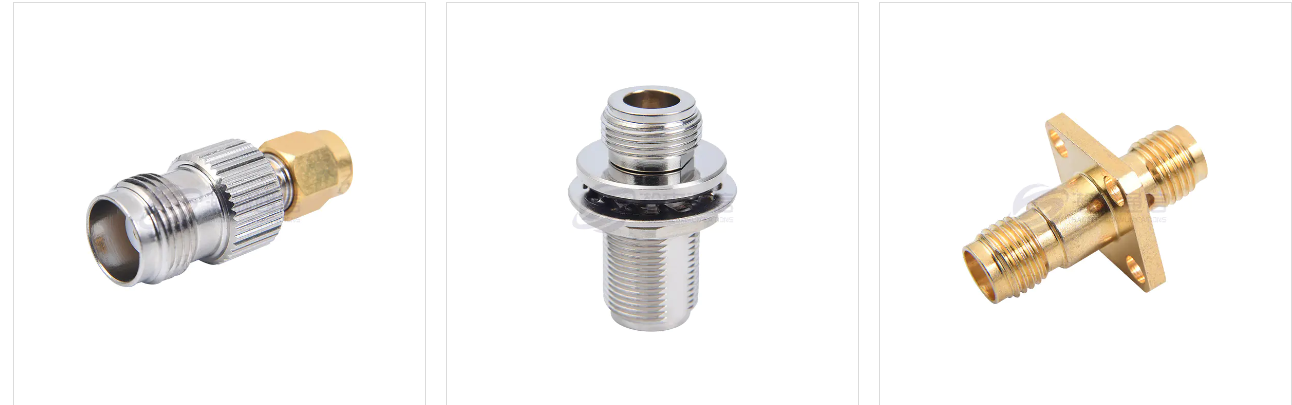
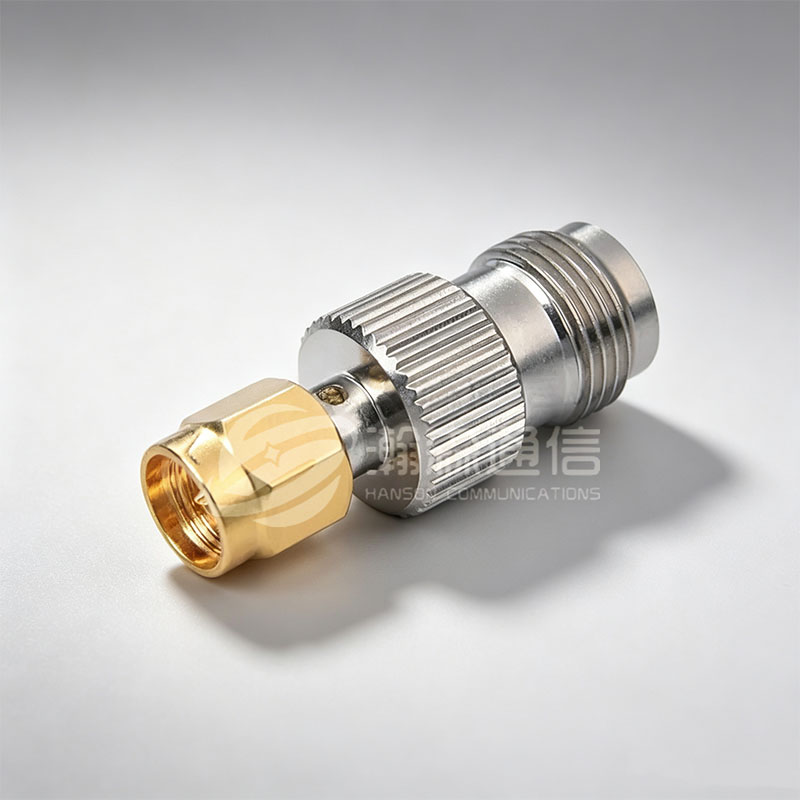
An RF coaxial adapter bridges the gap whenever two pieces of equipment or two cable assemblies use different connector families, different genders, or different mounting styles. Rather than replacing a cable assembly or a connectorized instrument, a single adapter restores compatibility in seconds. The sections below cover how each connector family performs, how a male to female RF coaxial adapter is typically applied, and where a 4 hole flange adapter fits into a panel mount design.
What an RF Coaxial Adapter Actually Does
An RF coaxial adapter is a short, rigid connector body used to join two coaxial interfaces that would not otherwise mate directly. It might change connector gender, change connector family, change impedance interface, or simply extend a connector orientation from straight to right angle. Because the signal path through an adapter is extremely short, a well made adapter adds only a small, predictable amount of insertion loss and reflection compared with running a full replacement cable.
A male to female RF coaxial adapter is the most common configuration engineers reach for on a bench or in a field kit, since it lets a male-terminated cable connect to another male-terminated device, or lets a female bulkhead jack accept a female-terminated cable, without needing a custom cable assembly built to order. Gender changers, family converters, and right angle adapters together make up the bulk of the adapters used in test labs, telecom installations, and production lines.
Comparing SMA, BNC, N, TNC and MMCX Connector Families
Each connector family was designed around a different balance of frequency coverage, physical size, and coupling method. The table below summarizes the practical differences engineers weigh when specifying a connector or an RF coaxial adapter between families.
| Connector | Coupling Method | Typical Use Case |
|---|---|---|
| SMA | Threaded, sub-miniature | Test equipment, wireless modules, general RF work |
| BNC | Bayonet quick-lock | Bench instruments, video and low frequency signals |
| N Type | Threaded, weatherproof capable | Base stations, outdoor antenna feed lines |
| TNC | Threaded version of BNC | Mobile platforms, aerospace, vibration prone mounts |
| MMCX | Snap-on, micro-miniature | GPS modules, compact wireless devices, internal PCB links |
Figure 1: Commonly referenced upper frequency ratings for standard commercial grade connectors. Precision versions of N and SMA interfaces can extend further.
Common Male To Female RF Coaxial Adapter Conversions
Most field kits and lab drawers carry a core set of conversion adapters that cover the majority of mismatch situations. Knowing which combination solves which problem saves time when a cable will not mate with an instrument port.
SMA Female to SMA Male Adapter
This is a pure gender changer within the same connector family, used whenever two male-terminated cables need to be joined, or whenever a female jack needs to present a male interface. It is one of the most frequently stocked adapters in any SMA-based test setup.
SMA to BNC Adapter
An SMA to BNC adapter lets a small threaded SMA cable connect directly to bench equipment fitted with bayonet BNC ports, a common need when moving a wireless module or antenna under test onto general purpose lab instruments.
SMA to N Adapter
An SMA to N adapter bridges compact SMA-terminated equipment to N-type antenna feed lines or base station hardware, which is a frequent requirement when connecting handheld or bench-top test gear to outdoor infrastructure.
SMA to TNC Adapter
An SMA to TNC adapter is useful whenever a device with a threaded TNC port, often chosen for its vibration resistance on vehicles or airborne platforms, needs to interface with SMA-terminated test cables or modules.
SMA to MMCX Adapter
An SMA to MMCX adapter connects compact internal MMCX pigtails, common on GPS and wireless modules, to external SMA-terminated antennas or test cables without needing to resolder the module connection.
| Conversion | Common Application |
|---|---|
| SMA female to SMA male | Joining two male cables or reversing jack gender |
| SMA to BNC | Connecting compact modules to bench instruments |
| SMA to N | Interfacing test gear with outdoor antenna feed lines |
| SMA to TNC | Vehicle and airborne platform connections |
| SMA to MMCX | Linking GPS or wireless module pigtails to external antennas |
Frequency Performance and Insertion Loss Behavior
Every adapter inserted into a signal path adds a small amount of insertion loss, and that loss generally rises as frequency increases. A well made precision adapter typically adds well under half a decibel of loss even near its rated upper frequency, but the exact figure depends heavily on connector geometry, plating quality, and mechanical fit between mating parts.
Figure 2: General reference trend for insertion loss increasing with frequency across a typical precision RF coaxial adapter.
Return loss follows a related pattern, since impedance discontinuities at the mating interface become proportionally more significant as wavelength shortens. This is one reason precision-grade connectors hold tighter mechanical tolerances than commercial grade parts rated for the same nominal frequency.

Power Handling Differences Across Connector Types
Physical size drives power handling almost as much as it drives frequency range, which is why the largest connector in this comparison, N type, also carries the highest typical power rating. Center pin diameter and dielectric spacing set how much current and voltage an interface can carry before heating or arcing becomes a concern.
Figure 3: General reference power figures at a fixed low frequency point. Actual ratings fall as frequency rises and vary by specific part design.
4 Hole Flange Adapter Mounting and Panel Applications
A 4 hole flange adapter is a panel mount or bulkhead style adapter built around a square or rectangular flange with four screw holes, rather than a simple threaded nut. This mounting style gives a secure, vibration resistant fixing point when a connector needs to pass through an equipment enclosure wall, a base station cabinet, or an aircraft bulkhead.
Why Engineers Choose a Flange Mount Over a Bulkhead Nut
A bulkhead nut style connector relies on a single central thread and a locking nut, which works well for general enclosures but can rotate slightly under repeated mating cycles. A 4 hole flange adapter distributes mechanical load across four fasteners, keeping the connector body fixed in place and reducing strain on the internal contact during repeated cable connect and disconnect cycles.
Typical Flange Mount Applications
- Base station and repeater cabinet feedthrough panels
- Test equipment front and rear panel connectors
- Aerospace and defense enclosure bulkhead connections
- Medical device housings requiring a fixed, non-rotating port
Flange styles are available across most connector families, so a 4 hole flange adapter can be specified in SMA, N type, or TNC interfaces depending on the frequency and power requirement of the panel it serves.
Comparing SMA, BNC and N Type Across Practical Selection Factors
When frequency range alone does not settle the decision, engineers often weigh connection speed, mechanical durability, and available mounting space against each other. The comparison below lines up SMA, BNC, and N type across five practical factors on a general reference scale.
Figure 4: Relative comparison across five practical factors on a general five-point engineering reference scale.
BNC scores well on connection speed because of its bayonet quick-lock action, which suits equipment that gets connected and disconnected frequently on a bench. N type trades that connection speed for higher power handling and stronger vibration resistance, which is why it remains the standard choice for outdoor antenna feed lines. SMA sits in between, offering wide frequency coverage and a compact footprint at the cost of lower power handling.
Material, Plating and Passive Intermodulation Considerations
Connector body material and plating quality directly affect both mechanical durability and electrical performance. Brass bodies with gold or silver plated center contacts remain the common choice across SMA, N type, and TNC adapters, since gold plating resists oxidation on the contact surface while brass provides a stable base for repeated threading cycles.
In telecom base station and repeater applications, passive intermodulation performance becomes a specific concern, since a poor mechanical connection or inconsistent plating can generate unwanted intermodulation products that interfere with adjacent channels. Manufacturers serving this sector typically test finished adapters on a passive intermodulation analyzer alongside standard network analyzer sweeps before parts ship to a customer.
Stainless Steel Versus Brass Bodies
Stainless steel bodies add corrosion resistance for coastal or marine deployments and outdoor base station sites exposed to humidity and salt air, while brass bodies remain the standard choice for general indoor and lab environments where weight and machining cost matter more than extreme corrosion resistance.
Working With an RF Adapter Manufacturer or Supplier
Selecting an RF adapter manufacturer involves checking more than the part number on a datasheet. Testing capability, plating consistency, and the ability to support custom RF adapter requests all shape how reliably a supplier can meet a specific project's frequency, power, and mounting requirements.
Ningbo Hanson Communication Technology Co., Ltd. is one example of an RF adapter factory that operates its own machining, electroplating, and assembly workshops rather than outsourcing production stages to separate vendors. The company focuses on RF coaxial connectors, adapters, high frequency cable assemblies, and low intermodulation cable assemblies, and works with a network of stable suppliers to support its in-house production. Products from this kind of manufacturer are commonly used across communication base stations, aerospace equipment, and medical device housings, sectors where consistent electrical performance across every shipped part matters as much as mechanical fit.
When evaluating an RF adapter supplier, engineers typically ask whether the factory can support OEM RF adapter programs built around a specific drawing or sample, whether in-house test equipment such as a network analyzer or passive intermodulation tester is available for finished part verification, and how the supplier handles custom RF adapter requests that fall outside a standard catalog configuration. A manufacturer running its own machining and plating workshops is generally better positioned to hold tight tolerances across a full production run than one that relies entirely on outside processing.
Installation and Torque Best Practices for RF Coaxial Adapters
Correct installation technique protects both signal quality and connector lifespan, and most premature connector wear traces back to one of the steps below being skipped during assembly.
- Inspect the mating interface for dirt, moisture, or damaged threads before connecting any adapter.
- Align the connector straight before threading to avoid cross-threading the coupling nut.
- Hand tighten threaded connectors first, then apply a calibrated torque wrench where the connector type specifies a torque value.
- Avoid twisting the cable itself while tightening, since torque should transfer through the coupling nut rather than the cable jacket.
- Support cable weight near the connector on fixed installations to avoid ongoing mechanical strain on the interface.
- Store unused adapters with protective caps in place to keep contact surfaces free of dust and moisture.
Bayonet style connectors such as BNC only need a quarter turn push and twist motion, and forcing a threaded tightening action onto a bayonet interface can damage the locking slots rather than improve the connection.
Frequently Asked Questions
-
Q1: What is an RF coaxial adapter
A: It is a short connector body used to join two coaxial interfaces that differ in gender, connector family, or orientation, letting mismatched cables and equipment connect without a custom cable assembly.
-
Q2: What is a male to female RF coaxial adapter used for
A: It converts a male interface to a female interface or the reverse, commonly used to join two male-terminated cables or to give a female jack a usable male connection point.
-
Q3: What is a 4 hole flange adapter
A: It is a panel mount adapter with a four screw flange rather than a single threaded nut, giving a secure, non-rotating fixing point for bulkhead and enclosure feedthrough applications.
-
Q4: What is the difference between SMA and BNC connectors
A: SMA uses a small threaded coupling and covers a wider frequency range, while BNC uses a quick bayonet lock and is common on bench instruments working at lower frequencies.
-
Q5: Can I connect an SMA cable to an N type antenna directly
A: Not directly, since the two connector families differ in size and thread, but an SMA to N adapter bridges the two interfaces without needing a new cable assembly.
-
Q6: What is an SMA to MMCX adapter used for
A: It connects a compact MMCX pigtail, common on GPS and wireless modules, to an SMA-terminated antenna or test cable without resoldering the module connection.
-
Q7: Are you a direct manufacturer or a trading company
A: Ningbo Hanson Communication Technology Co., Ltd. operates its own machining, electroplating, and assembly workshops, producing and supplying its own RF connector and adapter products.
-
Q8: What products can you provide
A: The main products are RF coaxial connectors, adapters including male to female RF coaxial adapter and 4 hole flange adapter configurations, high frequency cable assemblies, and low intermodulation cable assemblies.
-
Q9: Can you make customized RF adapters
A: Yes, custom RF adapter and OEM RF adapter requests are developed and produced according to customer drawings or samples.
-
Q10: How does your company ensure product quality
A: Each production process includes inline inspection, and finished parts go through a thorough inspection process aligned with customer requirements, supported by in-house network analyzer and passive intermodulation testing equipment.
-
Q11: Where do you mainly export your goods
A: Products are exported to dozens of countries including the United States, Germany, Japan, Spain, Italy, the United Kingdom, South Korea, Australia, and Canada.
-
Q12: How long does it take to get a reply after we send an inquiry
A: Inquiries are typically answered within twelve hours of being received.
Looking For Business Opportunity?
Request for a call today
-

+86-15715730755
-

-

No. 1, Longcao Road, Dongqian Lake Tourism Resort Industrial Zone, Yinzhou District, Ningbo City, Zhejiang, China.
Message
Copyright © Ningbo Hanson Communication Technology Co., Ltd.
