


 English
 русский
Industry News

How Do RF Coaxial Connectors Affect Signal Quality?
 2026.03.26
 Industry News
RF coaxial connectors directly affect signal quality through four primary mechanisms: impedance mismatch, insertion loss, return loss, and electromagnetic shielding effectiveness. A connector that is poorly matched to the system impedance, mechanically degraded, or incorrectly installed introduces signal reflections, attenuation, and noise pickup that degrade system performance — sometimes significantly. Conversely, a correctly specified and well-maintained RF coaxial connector contributes negligible insertion loss, maintains impedance continuity, and preserves signal integrity across the connector's rated frequency range. The choice between a 50 Ohm RF coaxial connector and a 75 Ohm RF coaxial connector alone can determine whether a system functions within specification or fails entirely.
Content
- 1 The Fundamental Role of Impedance Matching
- 2 Insertion Loss: How Connectors Attenuate the Signal
- 3 Return Loss and VSWR: Measuring Reflection-Induced Degradation
- 4 Shielding Effectiveness and EMI Isolation
- 5 Common RF Coaxial Connector Types and Their Signal Quality Characteristics
- 6 How Connector Material and Plating Affect Long-Term Signal Quality
- 7 Installation Quality: The Hidden Variable in Connector Signal Performance
- 8 Frequently Asked Questions
The Fundamental Role of Impedance Matching
Impedance matching is the single most critical factor in RF coaxial connector performance. In any RF transmission system, the source impedance, cable impedance, connector impedance, and load impedance must all be equal to allow maximum power transfer and eliminate signal reflections.
50 Ohm vs 75 Ohm: When the Wrong Choice Destroys Signal Quality
The two dominant impedance standards in RF systems are 50 ohms and 75 ohms, and they are not interchangeable. Connecting a 50 Ohm RF coaxial connector to a 75-ohm system creates an impedance mismatch at every transition point. This mismatch generates a voltage standing wave ratio (VSWR) of 1.5:1, which corresponds to a return loss of approximately 14 dB and a reflected power of approximately 4% at each mismatched interface.
In practical terms:
- 50 Ohm RF coaxial connectors are the standard for RF and microwave test equipment, radio transmitters, antenna systems, wireless infrastructure, and instrumentation. They are optimized for minimum loss at high power levels.
- 75 Ohm RF coaxial connectors are the standard for broadcast video, cable television distribution, satellite receivers, and consumer AV equipment. They are optimized for minimum signal attenuation in long cable runs at lower power levels.
Using a 50 Ohm RF coaxial connector in a 75-ohm video distribution system introduces reflections that manifest as ghosting or signal degradation in analog systems, and as bit errors or dropouts in digital systems. The mismatch penalty worsens as frequency increases.
| Mismatch Scenario | VSWR | Return Loss (dB) | Reflected Power (%) | Practical Impact |
|---|---|---|---|---|
| Perfect match (50Ω to 50Ω) | 1.0:1 | ∞ (no reflection) | 0% | Maximum power transfer |
| 50Ω connector in 75Ω system | 1.5:1 | ~14 dB | ~4% | Ghosting, digital errors |
| Typical quality connector (matched) | 1.05:1 | > 32 dB | < 0.1% | Negligible degradation |
| Damaged / corroded connector | 2.0:1 or worse | < 10 dB | > 11% | Significant signal loss and interference |
Insertion Loss: How Connectors Attenuate the Signal
Every RF coaxial connector introduces some degree of insertion loss — the reduction in signal power between the connector's input and output. In a well-designed, correctly installed connector, this loss is small but measurable, and it increases with frequency.
Sources of Insertion Loss in RF Connectors
- Resistive loss in contact interfaces: The contact resistance between mating connector surfaces dissipates signal power as heat. Gold-plated contacts with a contact resistance below 5 milliohms minimize this contribution.
- Dielectric loss in the insulator: The dielectric material separating inner and outer conductors absorbs microwave energy, with absorption increasing at higher frequencies. PTFE (Teflon) dielectrics offer significantly lower loss than polyethylene at frequencies above 3 GHz.
- Radiation loss at discontinuities: Any geometric discontinuity — a pin misalignment, a gap in the outer conductor, or a dielectric step — causes a portion of signal energy to radiate outward rather than continue through the transmission line.
- Skin effect losses: At high frequencies, current concentrates in a thin surface layer of the conductor. Rough or corroded contact surfaces increase effective resistance and insertion loss at these frequencies.
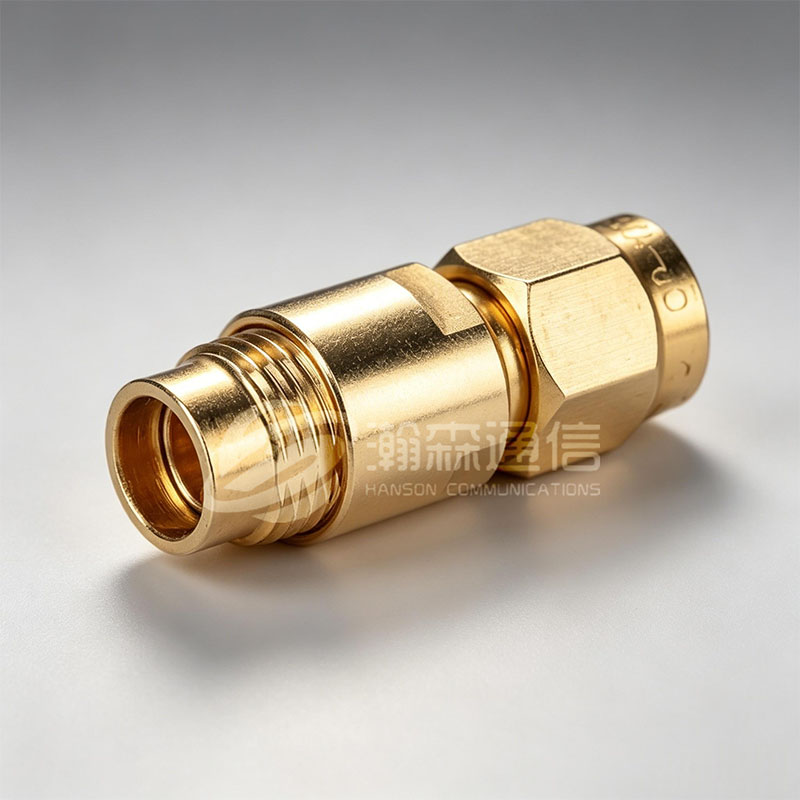
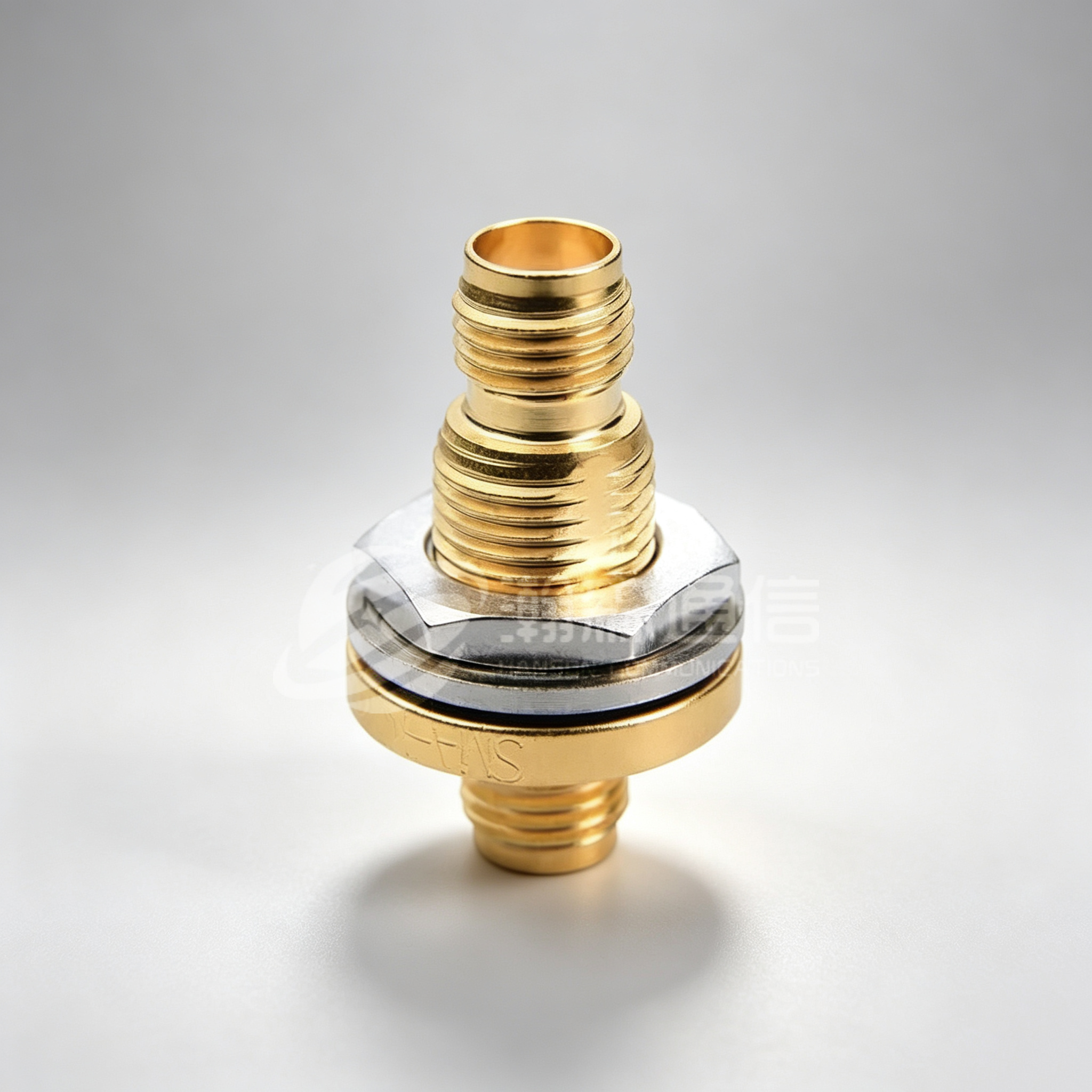
For a high-quality SMA connector (a common 50 Ohm RF coaxial connector), typical insertion loss is below 0.1 dB at 1 GHz and below 0.3 dB at 18 GHz. In a system with 10 connectors, this accumulates to 1 to 3 dB of connector-only loss — equivalent to losing 20 to 50% of signal power before reaching the load.
Typical insertion loss (dB) vs frequency for common RF coaxial connector types
Return Loss and VSWR: Measuring Reflection-Induced Degradation
Return loss quantifies how much of the incident signal power is reflected back toward the source by impedance discontinuities at the connector interface. A higher return loss value in dB indicates better connector performance — less reflection, more forward power transfer.
VSWR (Voltage Standing Wave Ratio) is an equivalent measurement expressed as a ratio. The relationship between return loss and VSWR is fixed: a VSWR of 1.5:1 corresponds to a return loss of 14 dB, while a VSWR of 1.1:1 corresponds to a return loss of 26 dB.
What Causes Poor Return Loss in RF Connectors
- Incorrect cable preparation — excessive or insufficient strip length creates a dielectric gap at the connector interface
- Over-tightening or under-tightening threaded connectors, deforming the inner conductor or outer shell geometry
- Using a connector not matched to the cable's outer diameter and dielectric dimensions
- Corrosion at the mating interface, increasing contact resistance and changing the local impedance
- Physical damage to the center pin — bent, recessed, or missing pins are a leading cause of return loss degradation in field-installed connectors
In precision RF systems, a return loss specification of better than 30 dB (VSWR better than 1.065:1) is commonly required at the connector. General-purpose RF coaxial connectors for commercial applications are typically specified at better than 20 dB return loss (VSWR better than 1.22:1) across their rated frequency range.
Shielding Effectiveness and EMI Isolation
The outer conductor of an RF coaxial connector provides electromagnetic shielding that prevents external interference from coupling into the signal path and prevents the signal itself from radiating outward and interfering with adjacent systems. Shielding effectiveness is measured in dB and represents the attenuation of external electromagnetic fields before they reach the inner conductor.
A well-designed RF coaxial connector with full outer conductor continuity achieves shielding effectiveness of 90 dB or more across most of its operating frequency range. A connector with a gap in the outer conductor, a loose coupling nut, or a damaged outer shell may reduce shielding effectiveness to 40 to 60 dB, making the system susceptible to interference from mobile phones, Wi-Fi, and other nearby RF sources.
Shielding Quality by Connector Design
- Precision connectors with full metal-to-metal outer conductor contact: Provide the highest shielding, typically above 90 dB. Required for sensitive measurement and communications applications.
- Standard commercial connectors with spring-finger outer contact: Provide 70 to 85 dB shielding, adequate for most telecommunications and industrial applications.
- Crimp-on connectors with incomplete outer shield coverage: May provide only 50 to 65 dB shielding, depending on crimp quality and cable braid coverage percentage.
Common RF Coaxial Connector Types and Their Signal Quality Characteristics
Different RF coaxial connector series are optimized for different frequency ranges, power levels, and application requirements. Selecting the correct connector type is essential for maintaining signal quality within specification.
| Connector Type | Impedance | Frequency Range | Typical Return Loss | Primary Applications |
|---|---|---|---|---|
| SMA | 50Ω | DC to 18 GHz | > 20 dB | Test equipment, wireless modules, antennas |
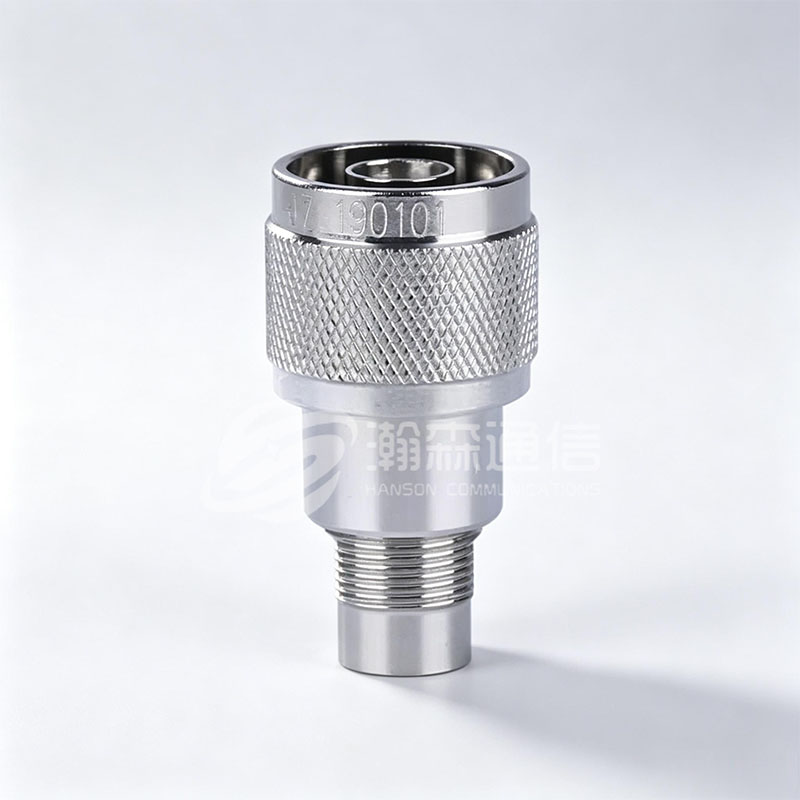
| N-Type | 50Ω or 75Ω | DC to 18 GHz | > 20 dB | Base stations, outdoor RF, high-power systems |
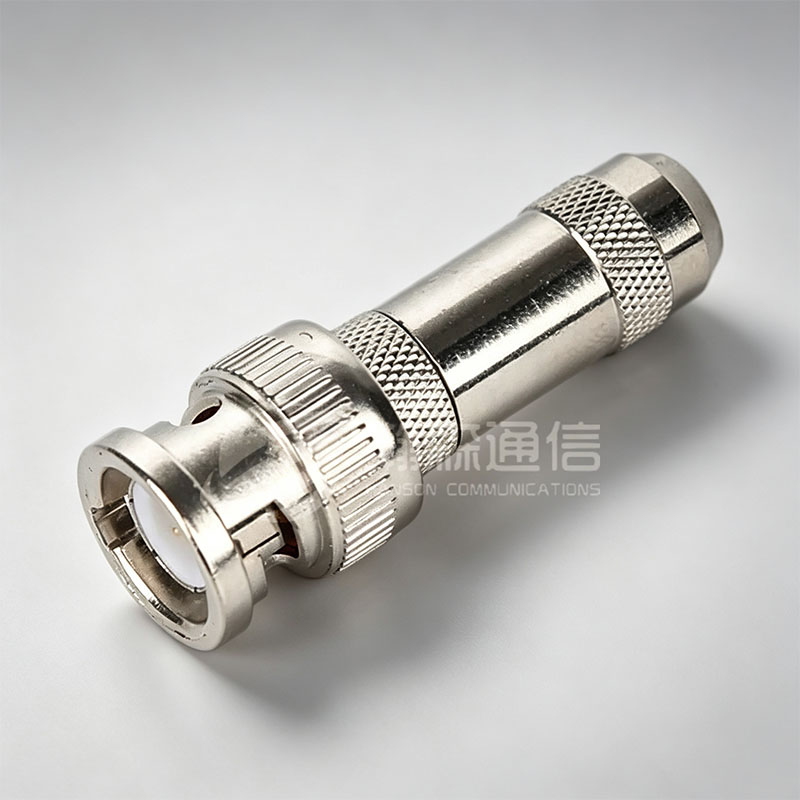
| BNC | 50Ω or 75Ω | DC to 4 GHz | > 15 dB | Video, lab instruments, data acquisition |
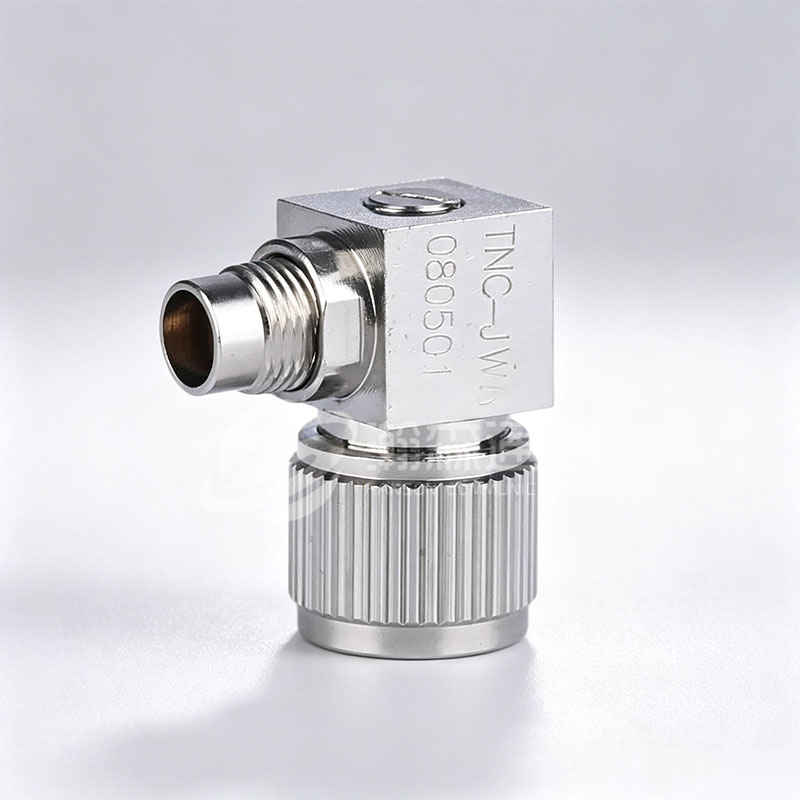
| TNC | 50Ω or 75Ω | DC to 11 GHz | > 20 dB | Mobile comms, avionics, outdoor enclosures |
| 2.92 mm (K) | 50Ω | DC to 40 GHz | > 26 dB | Millimeter-wave test, radar, 5G development |
| F-Type | 75Ω | DC to 3 GHz | > 15 dB | Cable TV, satellite TV, broadband distribution |
| RCA / Phono | 75Ω | DC to 1 GHz | > 10 dB | Consumer audio/video, composite video |
How Connector Material and Plating Affect Long-Term Signal Quality
The materials used in RF coaxial connector construction determine both initial electrical performance and how that performance changes over time and through repeated mating cycles.
Contact Plating Materials
- Gold plating (0.5 to 1.5 μm over nickel): The industry standard for RF connector contacts. Gold does not oxidize, maintains stable contact resistance below 5 milliohms over thousands of mating cycles, and preserves low insertion loss throughout the connector's service life. Specified for contacts in precision and high-reliability applications.
- Silver plating: Offers lower surface resistance than gold at high frequencies (due to silver's superior conductivity), but silver oxidizes and tarnishes, increasing contact resistance over time in humid environments. Commonly used on outer conductors where oxidation risk is lower.
- Tin plating: Lower cost than gold but significantly higher contact resistance after oxidation. Suitable for low-frequency and non-critical RF applications but degrades measurably in high-cycle or humid-environment use.
Dielectric Materials
- PTFE (polytetrafluoroethylene): The preferred dielectric for RF connectors operating above 3 GHz. Loss tangent of approximately 0.0002, making it one of the lowest-loss dielectrics available. Thermally stable from -65°C to +260°C.
- Polyethylene: Adequate for lower-frequency applications below 3 GHz. Loss tangent of approximately 0.0004 — roughly twice that of PTFE.
- Air dielectric (with support beads): Used in the highest-performance precision connectors. Air has a loss tangent near zero, and these connectors achieve the lowest possible insertion loss at any given frequency.
Installation Quality: The Hidden Variable in Connector Signal Performance
Even a precision-manufactured RF coaxial connector performs poorly if installed incorrectly. Installation quality is the most common cause of RF connector signal degradation in field-deployed systems, and it is entirely within the control of the installation technician.
VSWR vs frequency for correctly installed vs incorrectly installed SMA RF coaxial connectors
Key installation practices that directly affect signal quality:
- Apply correct torque: SMA connectors require 0.9 N·m (8 in-lb) of torque, N-type connectors require 1.36 N·m (12 in-lb). Over-torquing deforms the inner conductor; under-torquing leaves the outer conductor gap open.
- Use a calibrated torque wrench: Hand-tightening is not repeatable and consistently produces under-torqued connections with elevated VSWR, particularly at higher frequencies.
- Inspect center pins before mating: A bent or recessed center pin creates an impedance discontinuity that may be invisible to visual inspection but significant on a network analyzer.
- Clean contact surfaces before mating: Contamination on contact surfaces increases resistance and degrades return loss. Use dry nitrogen blast or lint-free swabs with isopropyl alcohol rated for connector cleaning.
- Limit mating cycles: Precision connectors have defined mating cycle ratings — SMA connectors are typically rated for 500 mating cycles. Beyond this, contact wear increases insertion loss and degrades VSWR.
Frequently Asked Questions
Q1 Can I use a 50 Ohm RF coaxial connector in a 75-ohm system? ▶
Physically, many 50-ohm and 75-ohm connectors of the same series (such as BNC or N-type) will mate mechanically, but the impedance mismatch creates a VSWR of 1.5:1 and a return loss of approximately 14 dB at each interface. For video and broadcast applications requiring signal fidelity, this is unacceptable. For non-critical low-frequency applications below 100 MHz, the mismatch effect is smaller and may be tolerable. For all precision or high-frequency applications, always match connector impedance to system impedance.
Q2 How many RF connectors in series are acceptable before signal degradation becomes significant? ▶
This depends on the connector quality and operating frequency. As a practical rule, each additional in-line adapter or connector pair adds 0.1 to 0.5 dB of insertion loss and degrades overall system return loss. For a system with a noise figure budget of 2 dB, even 4 to 6 connectors can consume a significant portion of that margin. Minimize the number of inline connections whenever possible, and use through-adapters only when necessary. In precision test setups, connector count is tracked explicitly in the system uncertainty budget.
Q3 How do I know when an RF coaxial connector needs to be replaced? ▶
Reliable indicators include: measurable increase in insertion loss compared to baseline (more than 0.5 dB increase is significant), VSWR above the connector's rated specification, visible wear, pitting, or gold plating loss on contact surfaces, a bent or recessed center pin that cannot be corrected, physical cracking of the dielectric insulator, and for threaded connectors, inability to achieve correct torque due to thread damage. In high-cycle environments, replace connectors proactively when they approach their rated mating cycle count rather than waiting for measured degradation.
Q4 Does connector gender (male vs female) affect signal quality? ▶
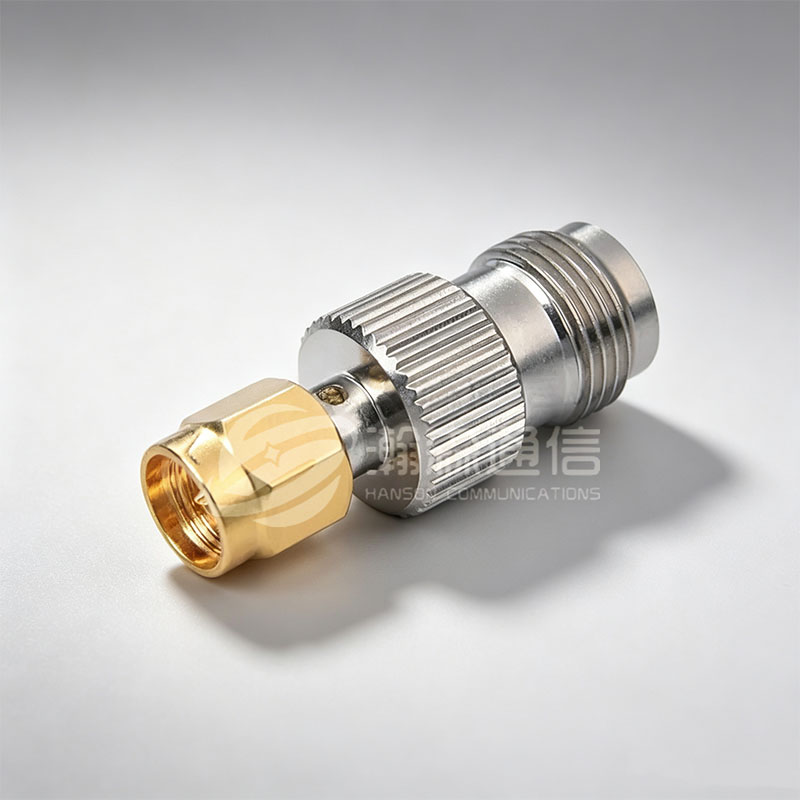
In precision connectors, the gender assignment is carefully designed to preserve impedance continuity through the mating interface. Male and female halves of the same connector series are designed as a matched pair — using adapters to change gender introduces an additional interface, and each adapter adds its own insertion loss and return loss contribution. For the lowest-loss connections, direct mating without adapters is always preferred. In field installations, using the correct cable assembly with the right gender on each end from the outset eliminates the need for gender-change adapters.
Q5 What is the difference between a standard RF coaxial connector and a precision RF coaxial connector? ▶
Precision RF coaxial connectors are manufactured to tighter dimensional tolerances than standard commercial connectors, typically holding center conductor diameter and outer conductor diameter to within ±0.005 mm rather than the ±0.02 mm tolerance of standard connectors. This tighter control produces more consistent impedance through the connector, resulting in better return loss (typically better than 30 dB vs 20 dB for standard) and lower VSWR variation between connector pairs. Precision connectors also typically specify a lower insertion loss at the upper end of their frequency range and carry a defined mating cycle rating. They are essential for measurement applications where connector uncertainty must be quantified and minimized.
Looking For Business Opportunity?
Request for a call today
-

+86-15715730755
-

-

No. 1, Longcao Road, Dongqian Lake Tourism Resort Industrial Zone, Yinzhou District, Ningbo City, Zhejiang, China.
Message
Copyright © Ningbo Hanson Communication Technology Co., Ltd.
